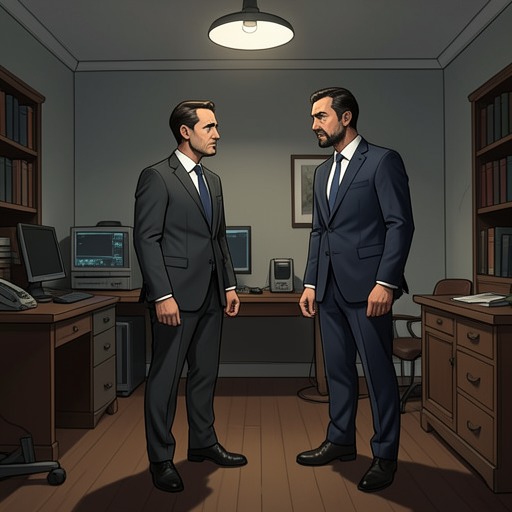
Rusty Sabich–Raymond Horgan relationship
Presumed InnocentThe Rusty Sabich–Raymond Horgan relationship is a professional bond transformed by a murder investigation and its courtroom aftermath. Horgan had relied on Rusty for twelve years; then, as a witness for the prosecution, he described how Rusty came to lead the investigation of Carolyn Polhemus’s murder and admitted that the disclosure Rusty withheld would have served them both better. Their conflict is not simply between former colleagues: it puts the obligations of professional loyalty beside the damage caused when private conduct becomes public evidence.
Professional Foundation
Horgan’s testimony sketches a career built in the same county institutions in which he and Rusty worked. Born locally, Horgan attended St. Viator’s High School on the East End, went to college for two years, and became a police officer after his father died. He spent seven years on the force, reaching the rank of sergeant while completing night law school. He later practiced criminal law in a three-person partnership before entering politics. The account gives him substantial experience in both law enforcement and prosecution, helping explain the authority he held over Rusty.
Rusty had served Horgan faithfully for a dozen years and sometimes prosecuted the county’s largest cases. The relationship therefore carried more weight than a routine chain of command: Horgan was the senior prosecutor whose confidence had shaped Rusty’s professional standing. During Horgan’s testimony, Rusty watches the former chief appear composed and assured, and recognizes the public manner that had made him persuasive. That same manner now lends force to testimony that threatens Rusty’s defense.
The Murder Investigation
Horgan described the established practice of assigning a deputy prosecutor to guide and assist police in a major case. Asked who made the assignment in Carolyn Polhemus’s case, he said that he and Rusty had decided Rusty should take that role. When pressed on how the decision began, Horgan could not recall whether he or Rusty first suggested it. He did remember that Rusty was glad to receive the case, showed no reluctance, and promised to pursue it vigorously.
The testimony makes the assignment a shared professional decision rather than an order imposed by Horgan alone. It also establishes Rusty’s eagerness to lead the inquiry—a detail that could be read as evidence of commitment to the work, yet carries a different implication once the jury hears that he had been involved with the victim. Horgan’s account thus places the former colleagues on both sides of the same fact: Horgan authorized, or at least jointly accepted, Rusty’s central role, while the prosecution uses that role to frame the case against him.
Trust Under Cross-Examination
The fracture in their relationship becomes especially visible when Sandy Stern confronts Horgan with Rusty’s years of service. Stern asks how Horgan can appear in court while a man who served him faithfully for twelve years faces the possibility of losing his life, yet say he would not have had the same confidence in him. Horgan looks toward Nico Delia Guardia, appearing sheepish, before answering that he wished Rusty had said something; disclosure, he acknowledges, would have looked better for Rusty and for himself.
That admission does not erase the physical evidence or the records in the case. Its force is instead relational and rhetorical. Horgan has been presented as a standard of propriety, but his answer reveals that his own position is implicated in the judgment he is helping the prosecution make. As Rusty understands Stern’s argument, the jury can distinguish between a failure to disclose private conduct and the charge of murder. Horgan’s regret supplies the defense with a way to loosen that connection without disproving the evidence.
The moment also reveals the limits of Horgan’s loyalty. His testimony does not deny that Rusty once had his confidence; it makes that confidence conditional on what Rusty should have disclosed. At the same time, Horgan admits that silence would have protected his own appearance as well. Their former professional trust is therefore neither wholly intact nor reduced to simple hostility: the courtroom exposes its dependence on candor, reputation, and the standards each man expects the other to meet.
Public Aftermath
The relationship remains unsettled after the trial. At a public ceremony for Mac’s induction as a judge, Rusty speaks and Horgan attends, since his absence would have been inappropriate. Rusty tries to avoid him. The scene offers no reconciliation or renewed argument; instead, the former colleagues occupy the same public gathering while Rusty keeps his distance. That restraint is consistent with a bond altered by testimony but not made irrelevant by it.
The wider publicity surrounding Rusty’s prosecution makes the professional rupture impossible to keep private. Newspapers and television turn the case into a national scandal, presenting the chief prosecutor’s murder charge alongside his affair with the victim. Rusty’s former status and his association with Horgan become part of the public story, while the trial subjects their history of service to scrutiny. The relationship’s significance lies in this conversion: a record of institutional trust becomes evidence to be tested, and even Horgan’s acknowledgment of Rusty’s service cannot restore the confidence that the proceedings have placed in doubt.